

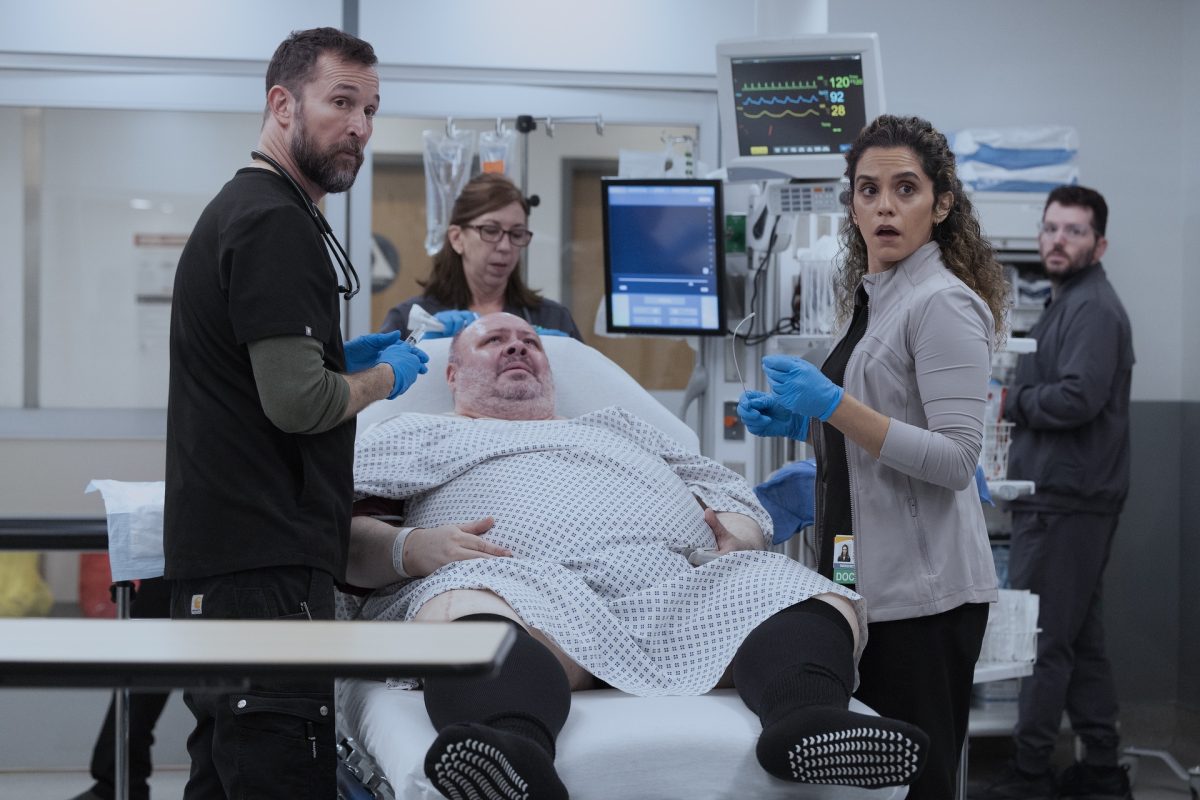
I fell in love with “The Pitt” several months after the first season aired. Not even 12 hours after I underwent an invasive, life-changing surgery, my father and I binged the first fifteen episodes of The Pitt. While I may have been a little (…a lot…) loopy from the pain killers, it did not diminish the fact that I was simply entranced by the show — it even led me to several months of hyperfixation on the medical drama.
So, one can imagine my excitement as, less than a month after my newfound fixation, the second season was scheduled to air. I even began my Thursdays with a Dunkin’ Donuts iced coffee to honor Night Shift Attending Physician icon, Dr. John Shen (Ken Kirby), whose love for the coffee brand was a staple to his character’s appearances throughout the end of the first season. Yet, as Thursdays continued on, I was looking less and less forward to the episodes and more so towards my early morning, caffeinated treat.
Despite still loving the show, as the season continued on, I began to feel as if the content was less thorough and more rushed. Supposedly an hour-long episode, being max 45 minutes, did not help this feeling — especially as we were spoiled in the first season with its 50 to 60 minute long episodes. While there were some shorter episodes in that first season, the average length was still longer. Missing five to ten minutes of a shift is significantly less than missing 15-20 minutes of a shift. And, it is safe to say that the missing minutes were felt.
While the end of the season may have been disappointing, the beginning had roped me in. Not only was I genuinely excited to see new content of my current fixation, but the way each character was reintroduced (and new characters were introduced) was insanely well done. The physical and psychological changes these characters had gone through between that first season and the second were clear. You could see the physical changes in Dr. Dennis Whitaker (Gerran Howell)’s increased muscle mass due to the fact that he had spent the last few months assisting a widow from the first season’s farm. Then, psychologically, with Dr. Mel King’s (Taylor Dearden) obvious anxiety regarding the lawsuit she was currently in.
It was obvious that these subtle, yet powerful, changes were well thought out and developed. However, we see fewer and fewer of these choices made as the season goes on, with the final five episodes feeling as if almost all of these subtle actions and messages were cut. As an audience, you see that something has happened, but it fails to show the buildup.
The last five episodes felt choppy, jumping from moment to moment in a way that caught me off guard. Rather than the smooth and cinematic scene shifts featured in season one and the first half of season two, we get a cut that feels as if you accidentally pressed skip on the remote. Of course, there is an inevitability that scenes and moments would have been cut due to timing — as happens in any sort of performance, especially in the world of theater and film — but they had time and space to keep these moments, and without them, everything went from multifaceted to flat.
Yet, the cases and realities discussed in these episodes were still as real and relevant as ever. While I may be grumpy about the lack of further character development compared to the previous season, the cases and moments throughout Season 2 are insanely important, with one being a standout.
Howard Knox (Craig Ricci Shaynak), a notably overweight patient suffering from a perforated diverticulitis — known as a severe complication in which an inflamed pouch in the colon wall tears, leading to a leakage of intestinal contents into the abdominal cavity. This case broke my heart, especially as Knox was apologetic for something he could not change, his weight, specifically after experiencing fat shaming from student doctor James Ogilvie (played by Lucas Iverson, who is much more charming than his character).
The discussion of weight in a medical sense is a slippery slope that is often not done in a real yet sensitive manner, especially in a time and space where skinny is “back” due to the rise of weight loss medications. However, I believe that this particular case shows the two sides of it all. The inherent biases of younger, inexperienced doctors (and frankly, experienced doctors as well, as shown via Dr. Cassie McKay’s (Fiona Duriff) character in season one) and the empathetic experience of veteran doctors, such as Dr. Jack Abbot (Shawn Hatosy), who is shown as a saving grace as Knox is transported to a facility with a machine that can accommodate his size.
Not only does this case highlight the importance of empathetic, compassionate medical care, but it also shows the thorough research and development each actor and writer has done for their characters. The ability to call back McKay’s past mistakes and indicate that she has grown and is willing to call out others for behaviors she saw reflected in herself is powerful. It allows the audience to see that these characters are human, and they do make mistakes (even big mistakes that lead to worsening conditions), while also seeing that the research is there.
The research for each character is well done throughout the whole season, from Whitaker discussing the Stormchasers, a Nebraskan minor league baseball team, to Dr. Michael “Robby” Robinavitch (Noah Wyle) being called out by an old Jewish grandmother for neglecting to attend synagogue as he continues to age. It truly disappoints me to see how, as the season came to an end, moments like these were fewer and farther between.
Despite all my disappointment in the final episodes of the season, I will be participating in a full day rewatch of it all. While season 1 may have been better, season 2 is still definitely worth watching. I know this review missed many important points and cases. I hope it encourages you to find time to watch this second season, and hope that in the confirmed season three, the writers, producers and directors will learn not to cut as many of the little, developmental scenes.



Julie • May 5, 2026 at 11:52 pm
I feel like the narcissism of Robbie just increased exponentially as the season went on. I will drop the unpopular view that I don’t like him.