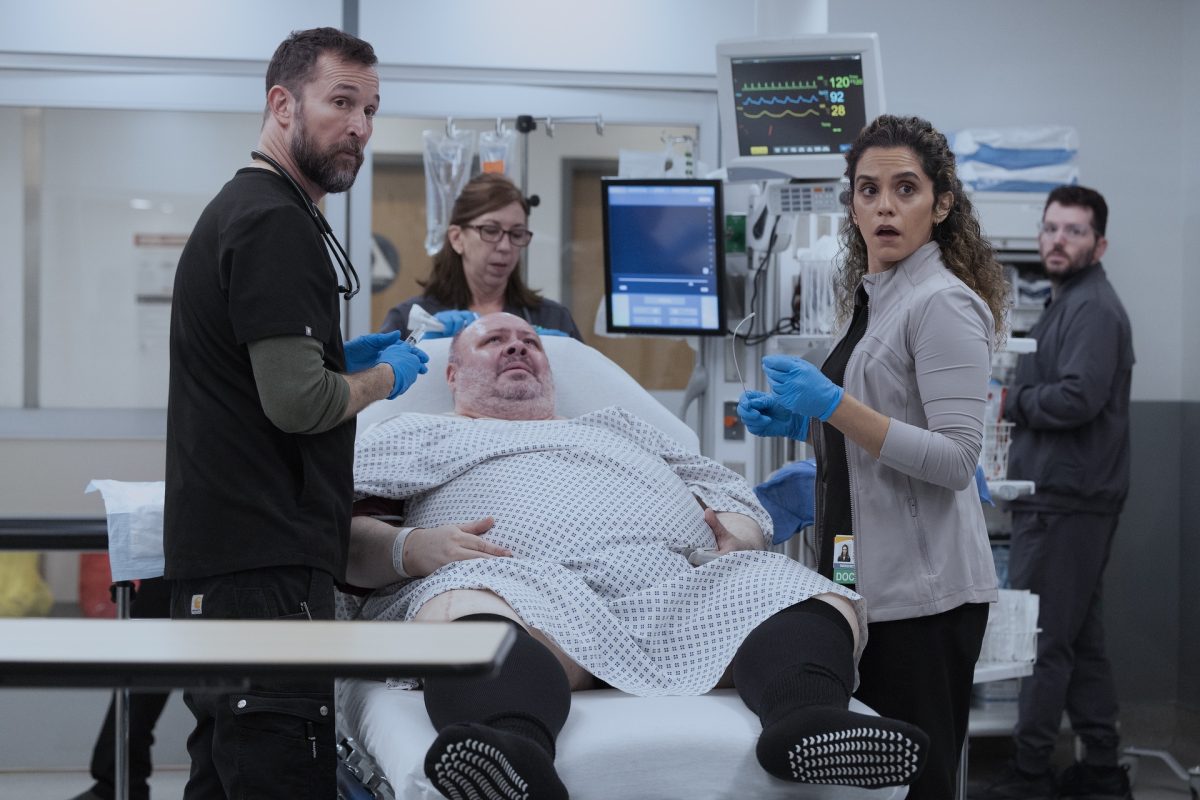

“I didn’t come here because I love Phoenix. I came here to help you get better. You can’t keep doing this to yourself.”
Since 1996, when he began his career in professional wrestling, the world has been all too familiar with Dwayne “The Rock” Johnson. After his trash talking turn as a heel, he transitioned to film roles starting in 2001 with “The Mummy Returns” and continued with appearances in the “Jumanji,” “Moana” and “Fast & Furious” franchises turning him into one of the highest paid stars in Hollywood. But for all his success, many of my fellow critics criticized him for his overly safe and mundane career choices.
Then in came director Benny Safdie, who, together with his brother Josh Safdie, helped rehabilitate the careers of both Robert Pattinson and Adam Sandler, in the crime thrillers “Good Time” (2017) and “Uncut Gems” (2019), respectively. He came to Johnson with a similarly gritty and meaty role that he had directed before, but more tailored to his own past experiences and wrestling persona. After it premiered to rave reviews at the prestigious Venice Film Festival Biennale, where Benny Safdie won the Silver Lion for Best Director, people began to realize that this film might actually amount to something. Adapted from a 2002 HBO Documentary film of the same name, here is “The Smashing Machine.”
The plot follows an early Mixed Martial Arts (or MMA) fighter named Mark Kerr (played by Johnson), who, after winning his first tournament in São Paulo, Brazil, joins the Ultimate Fighting Championship (or UFC) in 1997. Kerr soon decides to spend more of his time participating in the Japanese organization PRIDE FC, where the travel strains his relationship with his girlfriend Dawn (played by Emily Blunt, who was nominated for the Academy Award for Best Supporting Actress in 2023 for “Oppenhimer”). Adding in his burgeoning opiate addiction, which certainly does not help this relationship, Kerr begins to spiral out of control.
Sadly, the script and pacing may be the weakest elements of the film. At just over two hours, the simplistic dialogue and a relative lack of focus on the fight scenes lead to overly long scenes. At least the drama between the characters is well done.
When watching the movie for yourself, you may notice that the image looks a bit fuzzier than normal, and this was an intentional creative choice. Most films today are either shot on 35mm film stock or on digital cameras, and both are capable of an image quality around 4K. This movie was instead shot on 16mm film stock, which only contains as much detail as 1080p. This causes the film grain and artifacts to be a lot more noticeable to the average moviegoer, especially when blown up on a theater screen. There are also a few scenes shot on VHS videotape and IMAX 65mm, which help further immerse the viewer and show the relative passage of time.
The cinematography of the film is one of its most notable and well done aspects. While the fight scenes are somewhat infrequent, the way they are all shot from the perspective of a bystander looking in from just outside the ring is extremely visually dynamic. The sound design also helps, with each punch and knee to the face audibly resonating with a satisfying thud.
Sadly, Blunt’s character became less relatable as the film went on. She gave a great performance, but as Kerr worked to become sober, Dawn became less trusting of him. I understand her characterization if the boyfriend had been actively hiding something, but we can see that Kerr is being entirely forthright, and insulting someone for talking to their recovery mentor is in very bad taste.
Johnson also delivers his finest and most raw performance yet on film, and I would not be surprised if he receives an Oscar nomination for Best Actor come January. The makeup and hairstyling department on this film did an incredible job, and he completely transforms into this role.
There was a lot more about the film that I liked than disliked, and I would recommend it to anyone looking for a new side of The Rock. My final rating for “The Smashing Machine” is a solid 8/10.