

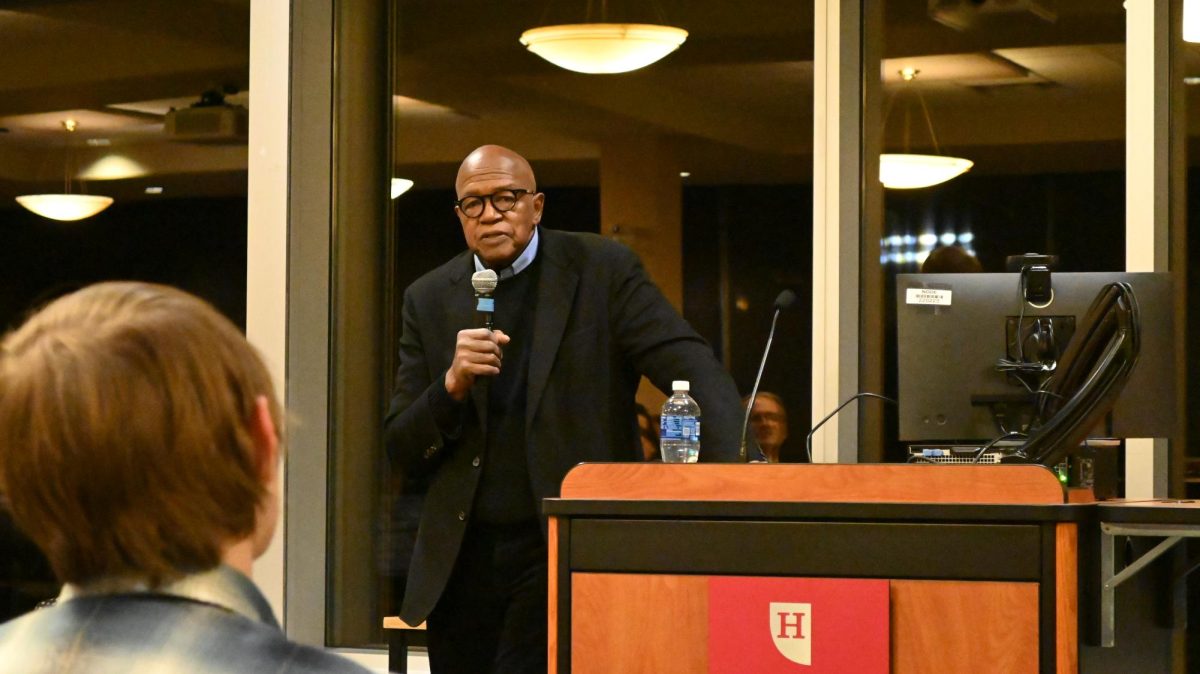
“Black success, white backlash”: these are the words of Dr. Elijah Anderson, an alum of Northwestern University, where he earned his PhD in Sociology, with a focus on urban inequality, ethnography, cultural sociology, social deviance, race relations and theory. He’s currently a professor at Yale University, where he teaches Sociology and Black Studies.
Hamline invited Anderson to the Kay Fredericks Room in the Klas Center on a cold Thursday night to speak about and explore how the everyday life of cities shapes urban spaces and reveals deeper insights into race, inequality and community. The discussion was structured around his research, and specifically a story he shared. The story explored his background and the beginning of his master’s studies, during which he became involved in his community and spoke to people society often looked down on, treating them only as stereotypes.
Anderson’s focus on black men in society came at a time in the 70s when social status heavily benefited from racism, and kept it long-standing. The west side of Chicago was the “wild west,” whereas the south side housed the middle class. The west side, as we know it, holds cultural significance to many Black African Americans, and the stereotype of it being occupied by the “wineheads” and “hoodlums” is severely offensive. As a young black man during this time, these stereotypes interested Dr. Anderson, and he decided to talk to these men, spending months asking them questions to better understand these “root dynamics,” as he called them.
The discussion, like any lecture, held many academic standpoints, and looking around the filled seats, the crowd was locked into every single word that came from his mouth; the room was silent other than the sound of pencils on paper as people wrote down what they were learning. A key figure from the first story he told is a man named Herman, a janitor he met at a bar he began frequenting to conduct his interviews. During his trip to the west side, he noted how the street people treated them with hostility. As they made their way down the sidewalk, they began to approach a group of men standing outside the bar.
“He begins acting like a junky, like he needs some drugs,” Anderson said about Herman.
Herman spoke to them, saying, “Let me smoke with you.” And the man who was once posed as a threat is now offering him a light and a cigarette.
“A Place on the Corner”, which is Anderson’s first book, explores this topic of social identification and systematic study of culture, and questions what might be a universal theme of human beings in our society. Ethnographers like himself contribute to bodies of literature, better described as a mosaic of science. When taking the time to speak to these men on the corner, he asked them how they described themselves, and they all said “regulars.”
They were nothing but human beings, but society chooses to label black men as opposed to knowing them and having them speak for themselves. This plays into the assumption that all black people come from the hood. But what happens when white people move into the hood? Exploring this topic of gentrification and “why do white people stay in the hood?” as posed by Anderson with junior Katarina Kocher.
“I mean, it’s like nobody cares. Like they’re stuck that way,” Kocher said. “But then white people move in and they get displaced again.”
This delves into the burden of racism and how it keeps a percentage of individuals stuck, yet the interest rises when the ones who need assistance are white, and as black neighborhoods lack resources and police turn a blind eye to crime in black areas. An explanation of this is that white people becoming “street-wise” and moving into black spaces turns white skin into capital for the privileged.
“Yeah, I think [race is] definitely important too, it’s an issue that needs coverage and like, awareness.But I feel like the problem with the students now is that they just don’t see it as an issue. They’re like, ‘Oh, like, I can just zone out and not pay attention, and this isn’t gonna pertain to me, this isn’t gonna bother me,’” Kocher said.
Anderson brought up the question of the sexuality of the black man in America and how it plays a role in the hurtful stereotypes in society. He discussed what he called “the mating game”, which is further detailed in his book ‘Code of the Street’ and in summary involves teenage pregnancy, multiple babydaddies, grandmothers caring for the babies, and of course, social structures.
“It’s like sex becomes affirmation for some people,” Anderson said.
Anderon’s lecture left a lasting impression on many people and has a depth of other scholars’ respect for his impact on the academic community and beyond including Assistant Professor in Social Justice and Social Change, Syeda Masood.
“It was interesting to see the man behind the fame,” Masood said.



Rose • Nov 20, 2025 at 7:20 pm
Thanks for sharing. Much detail and a great summary of the event. Thanks