The loss of third places
When I was a kid, anytime I wanted to hang out with my family or friends, I would ask my mom if we could go roller skating at St. North. Anytime we did, I remember us laughing and having so much fun and wanting to always go back. But when I googled it after many years since my last visit, I learned that it was permanently closed.
When it comes to having fun with friends or just trying to find a new place to entertain ourselves, there are not a lot of options unless you want to drive out to the suburbs. While there are a select few options, there used to be an abundance of these “third places” that we see in media from the 50s to the 90s, like ”Grease” (1978) or the TV show “Friends” (1994-2004).
For those who are unaware of what the term “third places” mean, the term was coined by Ray Oldenburg, an author who defines the term as a “generic designation for a great variety of public places that host regular, voluntary, informal and happily anticipated Gatherings of individuals beyond the Realms of home and work,” according to a Project for Public Spaces article.
Older films and TV shows have this nostalgia of the past and those third places where teenagers and young adults could go to hang out with their friends or to just have a place outside of home and work, or in the cases of teenagers, home and school. In “Grease,” the teenagers all had the diners or the drive-ins, while in “Friends,” they had the cafe. That is not to say that you cannot go find a local cafe to hang out at with your friends, but it won’t be the exact experience as we see in the TV show.
When you compare the films to our modern day, many of the hangout spots that we see depicted are no longer within the cities or are slowly dying out. When you look at third places, many think of malls, which films and TV shows tend to portray as a popular hangout spot.
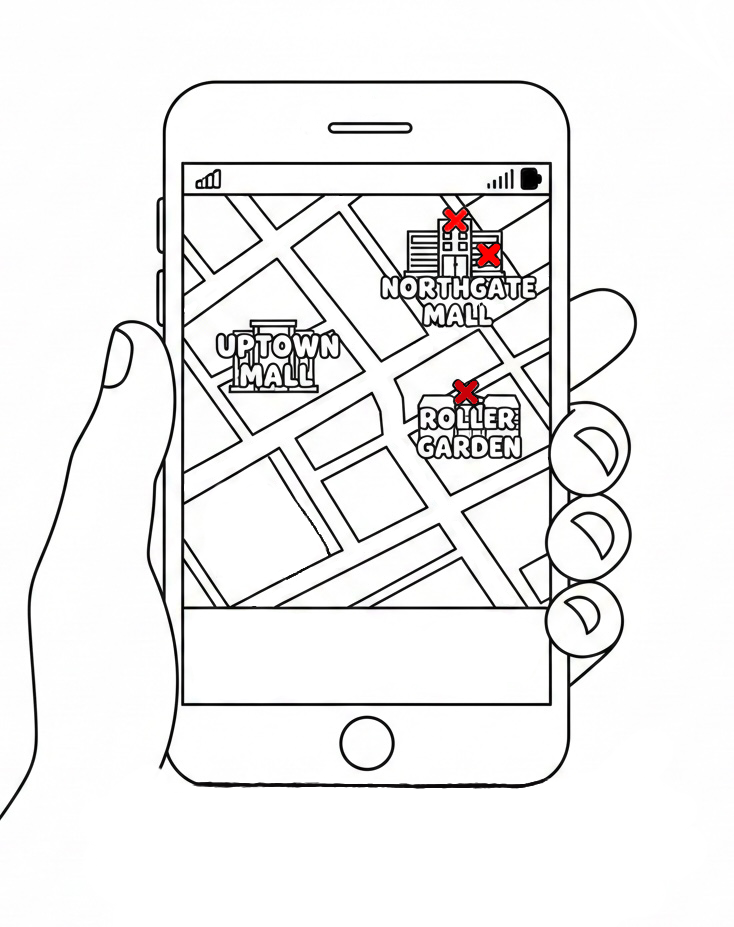
The reality is that not many young people tend to go to malls to hang out with their friends. An example of this would be Maplewood Mall. It is close by and easily reached by public transportation; however, if you ever stop by there, you will see a small handful of young people, but not a lot when compared to the Mall of America (MOA), although it has an amusement park. However, in terms of distance, MOA is the farthest mall that many travel to.
Following that same thread, many of the other third places like roller skating rinks, arcades and drive-in movie theaters either do not exist anymore, or you have to drive further out to the suburbs. After the pandemic, drive-in movie theaters became very hard to come by, with a few being either in parks or out in the more suburban areas like Litchfield, Minnesota.
When you look at roller skating rinks, there used to be a few roller skating rinks within the Twin Cities, like the old St. North roller skating rink in North St. Paul, which is now a church. While there are still a few roller skating rinks in Minnesota, like the drive-in movie theaters, you have to drive further out into the suburbs, which is not always ideal and may not work with everyone’s schedule.
There are a few arcades around the Twin Cities. An example would be Can Wonderland, although it is advertised as a miniature golf course, it also has an arcade within its building, which anyone of any age can go to, while some of the other arcades are further out and a few of them are in bars, so those twenty-one and older can enjoy.
When it comes to the reasons why third places have slowly faded, there are a multitude of reasons that I could list. The reasons I believe had the most impact, however, were the safety concerns of the younger folks, the rise of technology and the Great Recession of 2008.
The safety concerns of the younger folks have always been a thing and will continue to be one, but there has been a marked increase in protectiveness for teenagers, specifically in recent years.
With the rise of technology and everyone getting phones, some people choose to hang out in online chat rooms or online spaces. This means the normal amount of foot traffic in third places had dwindled
Lastly, the Great Recession of 2008 was not kind to anyone, especially businesses and the people who worked at these “third places,” which hurt foot traffic even more, and meant many of these “third Places” had to shut down or let people go.
I believe that we should bring back third places for people to not only have another place to build a sense of community within their neighborhood, but also because teenagers and young adults need spaces like these that can have fun with friends and unwind from school or work, as many adults have. If I had places like these to go when I was younger, I think I would have spent more of my time hanging out with friends and building those relationships and spent less time being bored at home and stuck on my phone.