“‘Your men don’t want you to defy the gods. But the gods say only you make it home. ‘Then I defy the gods.’”
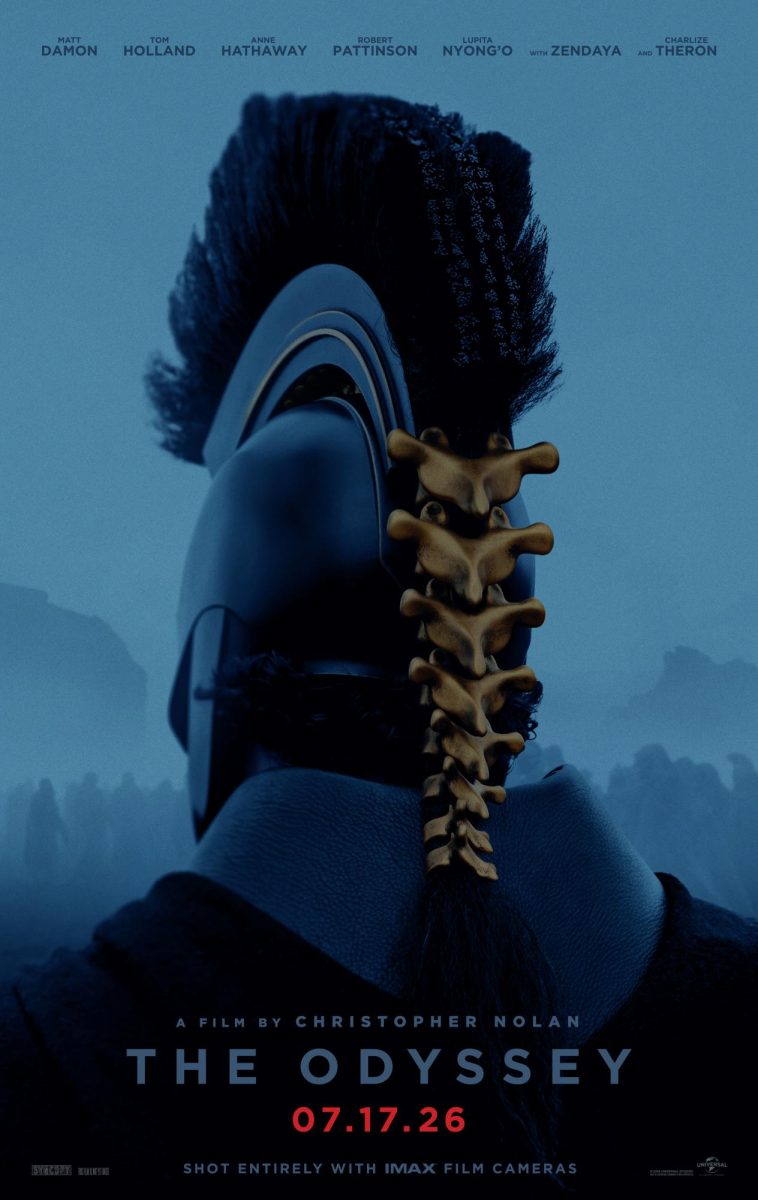
“The Odyssey” is a tale as old as democracy itself. To say that this story of the return of Odysseus, King of Ithaca, after his victory in the Trojan War is not one of the most famous and adapted stories of all time would simply be an understatement. However, Director Christopher Nolan is no stranger to putting his own spin on some of the most famous stories of our time. After his previous film “Oppenheimer” (2023) won Best Picture and Best Director at the Oscars, he decided to harken back to the grand Hollywood epics of old, and create an experience unlike anything else being made today.
Nolan’s proclivity to non-linear storytelling shows once again in this film, as most of the plot is told in media res with Odysseus (played by Oscar Winner Matt Damon, 1997’s “Good Will Hunting”) recalling his journey to Calypso (played by Oscar winner Charlize Theron, 2003’s “Monster”). The story also intercuts with his wife Penelope (played by Oscar Winner Anne Hathaway, 2012’s “Les Misérabes”) and son Telemachus (played by Tom Holland) having to fight off numerous suitors vying for the throne, including Antonius (played by Robert Pattinson). The rest of the ensemble cast include Benny Safdie as Agamemnon, John Leguizamo as Eumaeus and Himesh Patel as Eurylochus.
In contrast to many of his most famous compositions, including his score for “Oppenheimer,” Ludwig Görrenson’s is much more supplementary and draws less attention to itself. This is not necessarily a bad thing. Iit serves to support the action occurring on screen, but the times it stands out—like the opening shot of Ithaca—it truly shines.
As is the case with most of Nolan’s films, the sound design is extremely impressive and at times, deafening. Some scenes, particularly the numerous storms, were so loud that half my screening all plugged their ears in unison.
The cinematography by Hoyte van Hoytema is also stunning to behold. There are countless landscapes and vistas that simply took my breath away. He makes full use of the 4:3 Imax ratio, fully enveloping the viewer into the world of the film, and the texture of the 70mm film also gives the picture an analogue character to it that so many modern films are lacking.
The film delves into many elements of horror, and does so rather well. The scene with the cyclops was very suspenseful, neutralizing jumpscares effectively. The standout scene in the film though, was the visit to Circe’s (played by Samantha Morton) island. The animal transformations achieved using practical makeup were both terrifying and extremely realistic, reminding me of the work done in the 1981 film “An American Werewolf in London.”
Many people use the word epic to describe things that are simply great and well done, but the classical term has a much more narrow definition about the stories of legends. This film is a true epic, with scenic breathtaking vistas and immense scale and grandeur à la “Lawrence of Arabia” (1962). Those looking for the next action blockbuster may be disappointed by “The Odyssey,” but if you are willing to experience something more you will be rewarded. To see “The Odyssey” is to experience something truly grand. I highly recommend seeing the film on the biggest screen that you possibly can, and my final rating for “The Odyssey” is an epic 9/10.