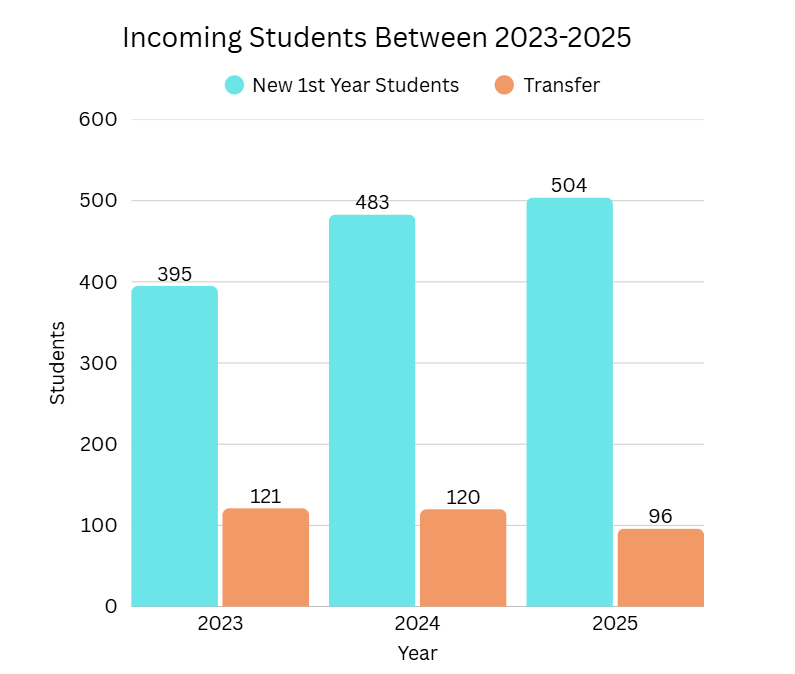
CORRECTION: It was previously stated that this current class of new undergraduate students has 96 transfer students. The new class of undergraduate students has 96 on-campus transfer students, but with Online Bachelor’s Degree Completion students, the total is 124.
Hamline University is celebrating a significant milestone this fall, welcoming a total of 600 new undergraduate students, the largest incoming class since before COVID-19. This cohort has 504 first-year students and 96 transfer students. The surge was a nice surprise to the admissions team, exceeding their goal of 483 students.
“The fact that we are over 500 for new students is a very nice surprise,” Undergraduate Admissions Director Jen Krengel said.
The growth is specifically notable given the current obstacles higher education faces nationwide.
“In higher education, one of the biggest things we talk about is an enrollment cliff where fewer students are enrolling in university,” Cassandra Thornton said.
Coordinator of Hamline’s New Student Programs (NSP). “So it’s always really exciting when you can see your class grow.”
The successful enrollment is the result of specific efforts in recruitment and communication. Krengel noted that her team made a conscious effort to adopt a more personalized approach.
“We really tried to focus on having a more student-centered voice so that prospective students could see themselves here,” Krengel said.
This was complemented by what Thorton described as a renewed push for authenticity, ensuring that,
“The student experience is conveyed not from a staff or faculty member’s mouth, but from students themselves.” Thorton said, “The New Student Programs team made multiple efforts to make the new admitted students more comfortable. Admitted student days were redesigned to be more celebratory and engaging.”
The admissions team initiated an effort to put a little more fun into the events, which included adding raffles and other highlights. The admissions office made an effort to work more closely with Thornton’s team and academic advising to provide a seamless transition from applicant to enrolled student.
From the transfer student side, the new admissions were not a surprise, but “In line with what we have been seeing enrollment-wise in recent years,” the Associate Director of Admissions, Kia Sherburne, said.
This outcome is attributed to proactive efforts, as the University has spent the last few years working on developing major-specific transfer pathways with the metro-area community colleges, to ensure that the process of transferring is as smooth as possible for our incoming students.
The larger class size presented logistical challenges for orientation.
“Hamline was truly made to be an academic space, not an event space,” Thornton said. “So then when you have a larger class, you have to figure out, okay, where can we have all students together?”
To support the transition, Hamline has robust programs in place. Transfer students receive specialized attention.
“[Transfers have] their own orientation day so they can get acclimated to the campus and meet Hamline staff and other new transfer students,” Thornton said.
Looking ahead, University leaders are mindful of the growth. Krengel said the current size brings Hamline back to a comfortable place size wise after smaller numbers during the pandemic. However, there is a clear focus on sustainable growth. As Thornton stated, it is “particularly important that we’re also making sure that if we’re inviting new students, we have systems and things to support them.”