“This is the only pure thing in this world. The fire came from the mountain. Burnt our forest. My people cried for help, but Eywa did not come.”
When director James Cameron swept the 70th Academy Awards with his 1997 film “Titanic,” tying the all time record at 11 wins, he proceeded to take a short break from the industry, only making a few documentaries about the ocean. 12 years later, in 2009, Cameron released the original “Avatar,” which is currently the highest grossing film of all time. Finally, in 2022, he released “Avatar: The Way of Water,” cementing the franchise as more than just forgettable popcorn fare.
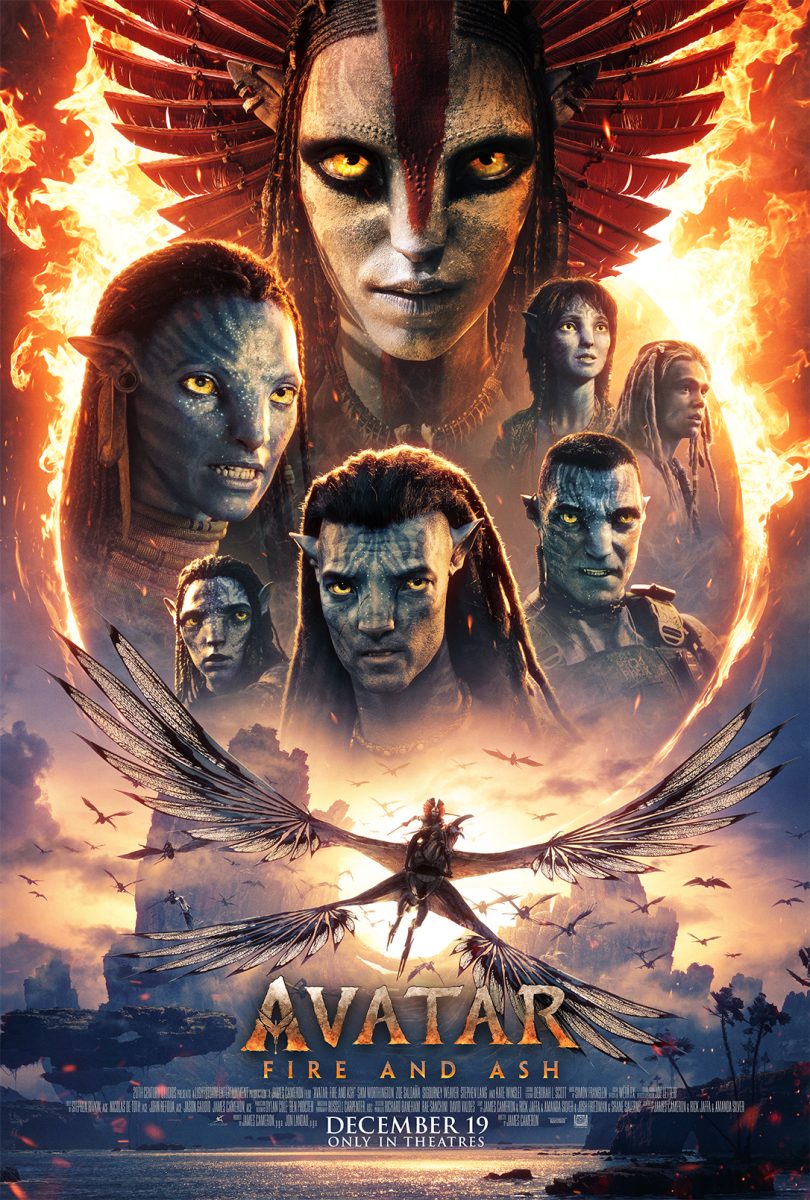
Now, with the third instalment in the series currently in theaters and tearing up the box office with over a $1 billion gross, I thought it was as good a time as any to discuss the film. So put on your 3D glasses and step into the alien world of Pandora.
The plot once again follows the Sully family as they travel across their world while defending it from the human led Resources Development Administration (or, RDA)RDA. Jake (played by Sam Worthington) and his wife Neytiri (played by Academy Award winner Zoe Saldaña, for 2024’s “Emilia Pérez”) their adopted human son Miles “Spider” Socorro (played by Jack Champion) accompany Spider back on his return to a human settlement, but they are all attacked Colonel Miles Quarritch (played by Stephen Lang) as he tries to arrest Jake.
To do this, Quarritch meets with the chief of the fire clan, named Varang (played by Oona Chaplin, the granddaughter of Charlie Chaplin), who allies herself with Quaritch. Their dynamic together is interesting, pulling Quarritch between the two worlds of the Na’vi and humanity.
If there was one performer that audiences have been claiming was dragging the film down, it would be Jack Champion as Spider. Because the nature of his character means that he is always acting against CGI characters and blue screen, it is understandable why his performance was a little wooden. The fact that he takes up a large portion of the movie’s plot in the second half simply makes this issue more apparent.
Speaking of the special effects, tThe “Avatar” series has always had some of the most impressive and extensive VFX work of any Hollywood movie, and this film does not disappoint. The photorealistic water looks as good as ever, and the extensive use of fire is also beautiful to behold.
One complaint I did have about the movie was the extended use of high frame rates. Most films are shot at the industry standard rate of 24 frames per second, which we have been trained to see as normal and cinematic when watching. Almost half of the film is instead presented at 48 frames per second, which can create a jarring contrast between scenes and disrupt your immersion.
When the Oscar nominations were announced earlier this month, the film earned an expected nomination for Best Visual Effects and a surprise acknowledgement in Best Costume Design. Both were good nominations, and it will almost certainly pull off a win in Best Visual Effects come March 15.
If you loved the previous two “Avatar” films, I would recommend that you see this one on the biggest screen that you can. My final rating for “Avatar: Fire and Ash” is a vibrant 8/10.