
To remember those who have been killed and continue to be harmed by Immigration Customs and Enforcement (ICE) in Minnesota, the Muslim Student Association (MSA) held a vigil on Friday, Feb. 13 in the Bush Ballroom. The event was also raising funds for Masjid Da’Wah, a local mosque in the Hamline-Midway community that has been directly impacted by Operation Metro Surge.
Jummah Prayer, Mourning and Faith
MSA intentionally planned the vigil to align with Jummah, a weekly prayer Muslims do on Fridays.
“‘Jummah’ directly translates to ‘gathering’ so we thought, ‘what’s a good way to host a space where people can come together and just reflect and mourn together?’ because there’s so many things that are happening around us and so many different people telling us we can’t really do anything about it, and so when you’re feeling hopeless, it’s still very important to be in space together, have faith together,” MSA president senior Hanan Abdi said. “Faith can be personal, but it can also be communal, so if we’re speaking out and holding spaces like this together, I think it’s necessary to have a vigil.”
The prayer was led by MSA Jummah leader first-year Ayub Mohamed, who spoke of his own upbringing being Muslim and a minority, and also to the pain many have felt in our state.
“He spoke really well, and he talked about a lot issues, things that the Muslim community and minorities in general have been facing recently, and he spoke in a way that was just very nice in general,” senior and MSA general club member Muna Wardere said.
Attendees, whether or not they were Muslim, were invited and encouraged to pray.
“There were people who are not Muslim that were praying with us and whenever that happens I’m just like ‘wow, these people are really dedicated’ and I respect them so much and it makes me feel so much better seeing on campus,” Wardere said.
Following Mohamed, Chaplain Kelly Figueroa-Ray spoke about how current events are not new in the United States for people of color, stating that “there are no safe places”, and speaking about fear, saying that it is okay to be afraid, but fear can also be motivation to be courageous. She also emphasized that beyond Renee Good and Alex Pretti, that there are many more victims who have died at the hands of immigration enforcement whose names go unnoticed because they are not white.
Raising Funds for Masjid Da’Wah
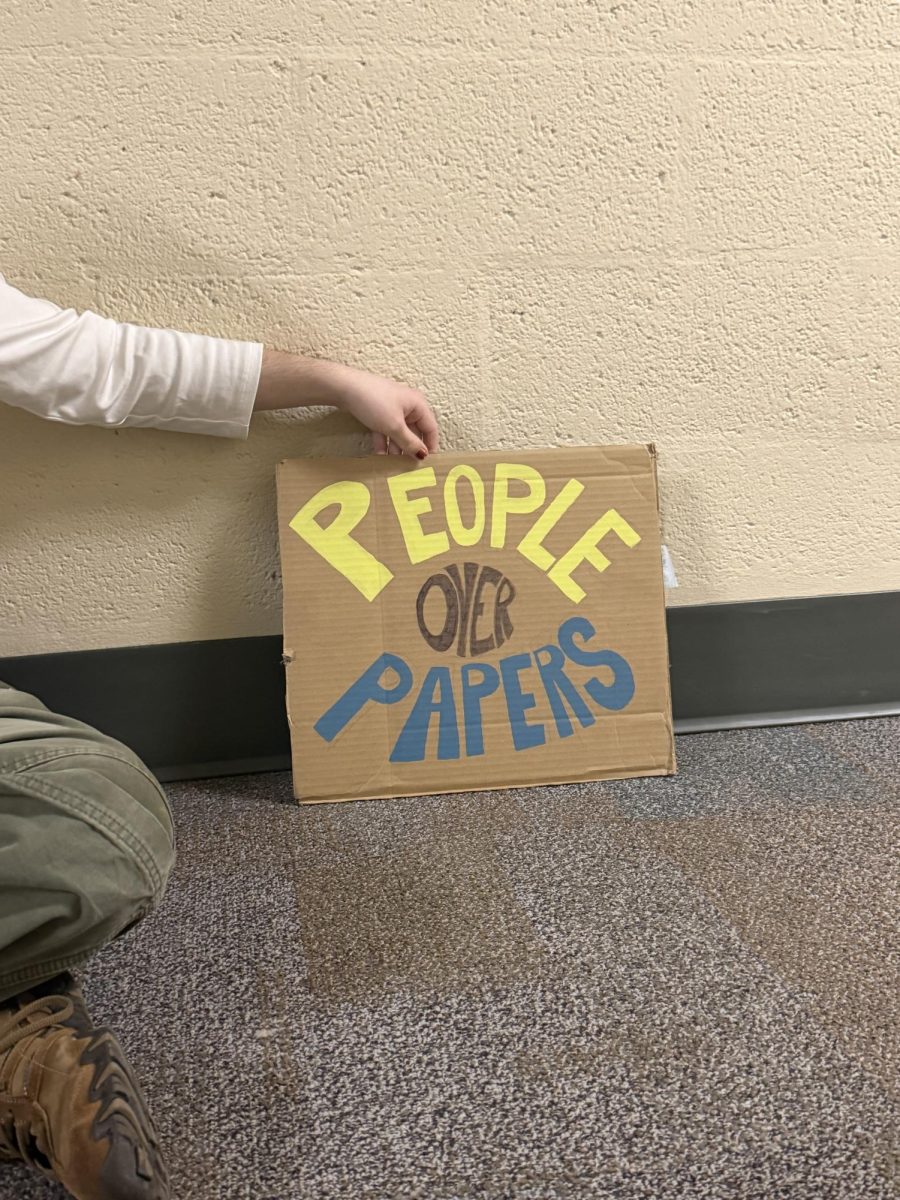
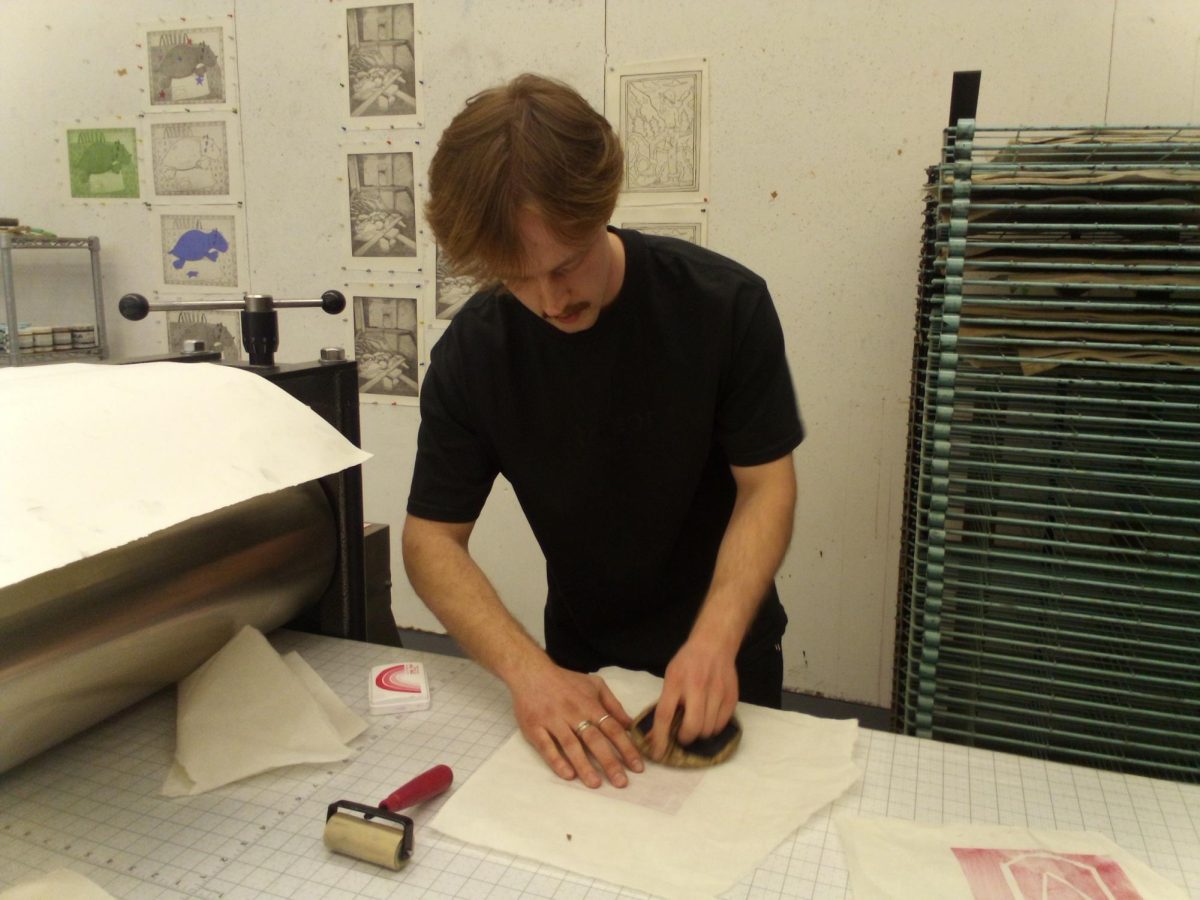
After the Jummah prayer, a printmaking activity led by the Hamline University Sculpture Guild and studio art students took place at the vigil, with prints created by carving into linoleum three days earlier. On Tuesday, Feb. 10, the Sculpture Guild and MSA collaborated on a pre-vigil art build in the printmaking studio in Drew Fine Arts.
The collaboration came about as MSA had been planning a vigil and the Sculpture Guild was originally intending to do a protest sign making event. Senior Clare Friar, who is a studio art major with a concentration in printmaking and has personal connections with the people in both organizations suggested an art build to help raise funds for Masjid Da’Wah.
“There’s been a lot of organizing among the Hamline community to meet each other, get connected with each other, and also just to meet people who live in the Hamline area, and so I’ve been trying to connect with the Da’Wah mosque in the area because they’re seeking urgent rent relief, and they’re also asking for community support when they’re having weekly service prayer time for people to be sort of present,” Friar said.
Abdi noted the importance of raising funds for the mosque especially when so many are currently living in fear.
“People are afraid to go to Masjid as they often do and so the mosque is not receiving as many donations it usually does, and so they are not able to pay for their mortgage, their monthly payments, so we’re helping them be able to pay rent,” Abdi said.
Friar also noted that as college students, there are many resources at hand that are difficult to come by in most other settings.
“We’re privileged to have things like club funds that you know, are coming out of our tuition that allow us to do events like these with no material cost and stuff like that so that we can give it to people and then take a hundred percent of what we’re asking the suggested donations, and use that for mutual aid,” Friar said.
Art as Resistance
The choice to make prints came as Friar and Sculpture Guild president senior Soren Goebel noted that it is a skill many studio art students already are capable of doing, and it is a simple way to spread awareness fast.
“You don’t have to have any other skills other than being able to just sketch out an idea,” Goebel said. “You know, it’s not something that has to be done super clean or done really well, and then further than that, you can print a bunch of them at once and spread them around.”
Friar highlighted that students in the Printmaking 1 class taught by professor John-Mark Schlink are assigned to make protest prints.
“He has an assignment for Printmaking 1 studio students where he makes you make a protest print, and so I think a lot of people in the department are pushed by his teaching to engage with political art,” Friar said.
Goebel spoke as well on the intersection of art and activism.
“I feel like art is often at the center of activism. Artists and people thinking creatively tend to be more tuned into what’s going on in the world, I think and are often the first ones to speak about it,” Goebel said.
During hard times, gathering and creating art can also foster a sense of community.
“I think people use art as a form of resistance, so self-expression, collective expression can be something powerful that people can bring together, especially in moments like this where we need everything and anything we can put on the table in order to resist,” Abdi said.
Community-centered events combined with art can also be healing for many, especially during times of communal trauma.
“It’s been nice to sit around with my friends, giggle, you know, and not make lightheart of something that’s super serious but to allow space for, you know, other stuff and other feelings too to happen, and the same feelings that you know, drive us to make art like this,” junior Layla Stenson said.
During the printmaking portion of the vigil itself, with the help of Sculpture Guild members and studio art students, attendees were able to print designs that were made at the art build onto blank t-shirts and paper to take home.
“I got free shirts, a lot of people got free shirts and it’s a shirt with things that I believe in and I think it’s really cool that other students made them,” Wardere said.
Continuous Remembrance
MSA is a group under the larger Multi-Faith Alliance (MFA). While they are the first to hold a vigil on campus, other organizations under the MFA will be holding vigils of their own, with the Christian Campus Ministry holding one on Wednesday, Mar. 18 at 7 p.m., and HU Mindfulness & Meditation and Jewish Student Life holding a joint vigil on Tuesday, Apr. 7 at 4 p.m.
As for why it is important for vigils to be held monthly, Abdi explained that remembering victims of ICE is continuous.
“What we’re basically doing is continuing to remember the people who have not only [been unjustly killed but also continue to face harassment and continue to be scared of ICE presence, and so we want to make it a continuous thing because this is still happening and it will continue to be in our hearts,” Abdi said.